
Working project managers
"I've tried AI on a status report. Now what?"
You get
A lifecycle you can run next Monday, a 90-day plan, and a way to commit to a date from a range without betting the contract.
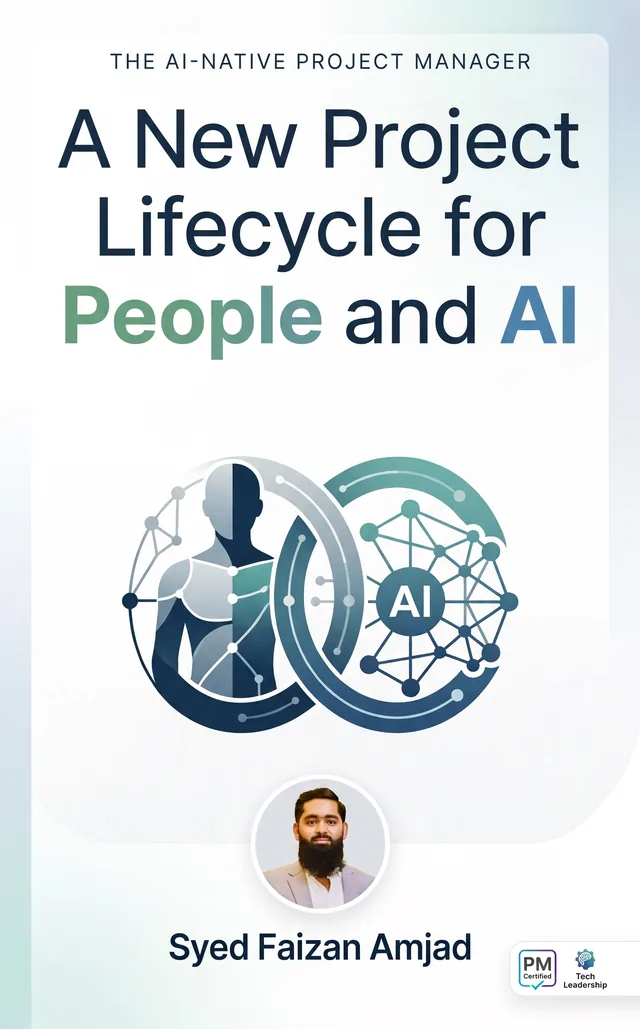
A New Project Lifecycle for People and AI
The project lifecycle, rebuilt for teams of people and AI, by a project manager who runs one. AI now drafts the charter, builds the schedule and writes the status report. The lifecycle was not designed for that. This book gives you one that is.
Also coming to Kobo.
The idea at the centre
The Governed Loop replaces the straight line with a cycle. Tap a phase to see what it does.
Decide what the project is for, what data it runs on, and what “done” means, before anything is drafted.
Let the machine explore plans and ranges. A person chooses the date and makes the commitment.
Design the workflow of people and AI agents. Every agent gets a written charter and a named owner.
Triage the flood of signals modern tools produce so the right ones reach a person in time.
Close so the next project starts smarter: what the machine learned, what the team learned, what to keep.
Who it's for
"I've tried AI on a status report. Now what?"
A lifecycle you can run next Monday, a 90-day plan, and a way to commit to a date from a range without betting the contract.
"How do I make this a standard, not one person's habit?"
A half-page PMO note at the end of every chapter, a 12-month roadmap, and templates your office can adopt as-is.
"I know one method. Is it already out of date?"
Every method and acronym defined the first time it appears, a full glossary, and the mapping to PMBOK, PRINCE2 and Scrum.
From the preface
I have been managing projects and products for more than ten years, across software as a service (SaaS), financial technology, healthcare technology, government technology, and, most recently, AI automation. I hold the Project Management Professional (PMP) certification, the credential issued by the Project Management Institute (PMI), and I completed a master’s degree in product management at the University of Virginia after a bachelor’s degree in software engineering. Today I head project management and business analysis for a healthcare software vendor in the United States, and I co-founded Aptagon Technologies. I say all of this not to impress you but to explain the vantage point of this book. I write as a working project manager who still runs projects every week, not as an analyst or a vendor.
For most of those years the job worked the way the textbooks said it did. I gathered information nobody else had, turned it into a plan, and kept the plan honest as the world changed. Then, at some point, that stopped being true.
The change did not announce itself. In 2024 I gave a generative AI tool its first real assignment on one of my programs, and I chose it deliberately: a software requirements specification for a project that was already running and already documented, so I could compare what the machine produced against a document I knew to be right. I gave it the project context, the team, the resource picture, and what the stakeholders expected. The requirements section came back better than I had braced for. It had understood the problem. The rest of the document was another matter. I had asked for the IEEE structure that our clients recognize, and the tool had not followed it; the sections were in the wrong places, the traceability was missing, and I spent the better part of two evenings rebuilding a document I had only intended to test. It was, frankly, a miserable experience, and it left me with the question that runs through this book: if the machine can understand the requirements this well and still hand me something I cannot use, whose job is it to close that gap, and where in the process does that job live?
Two years later the same task looks different. I describe an idea to an assistant, it drafts the documentation, I review it, and once I approve it the document is posted to Confluence and shared with the team without my touching a keyboard again. The tool matured. My question did not go away. It became the subject of this book.
That question is the reason this book exists. The machine had not taken my job. It had taken the parts of my job that the process described, and left me with the parts the process never mentioned: deciding what the project was for, judging whether the plan was worth committing to, telling a sponsor a hard truth, and being the person who answered for the result.
Every project manager I know has tried a chat assistant on a status report. Far fewer have asked what happens to the lifecycle itself when drafting, tracking, and reporting stop being human work. I did not ask that question either, at first. I bolted the new tools onto the old process and got what most people get: faster steps and the same bottleneck, which was me.
Across the multi-team projects I have led since then, the same pattern kept showing up. A draft moved faster than the checking of it. An automated step ran and nobody was sure who owned the result. A plan looked finished because it was well formatted, not because anyone had tested its assumptions. None of these is a dramatic failure on its own. Together they taught me that the risk of AI in project work is rarely the machine doing something wild. It is the machine doing something plausible that no person examined before it became a commitment.
The projects that went well were the ones where I had designed the workflow around the tools, decided in advance what a person had to check, and named who owned each outcome. The ones that strained were the ones where the tools had simply been added. Out of that experience came the idea at the center of this book. The five phases every method already uses (initiating, planning, executing, monitoring, closing) still hold. What changes is who does the work in each and what the person in charge must never hand over.
The preface continues in the book, followed by fourteen chapters, four appendices and a glossary.
Get the book
About the author
Ten-plus years leading product and project delivery across SaaS, FinTech, HealthTech, GovTech and AI. Heads project management and business analysis for a US healthcare software vendor; co-founder of Aptagon Technologies; M.S. Product Management, University of Virginia.
This is the book about how to make that arrangement work. Buy direct for the PDF + EPUB bundle, or from your usual store.